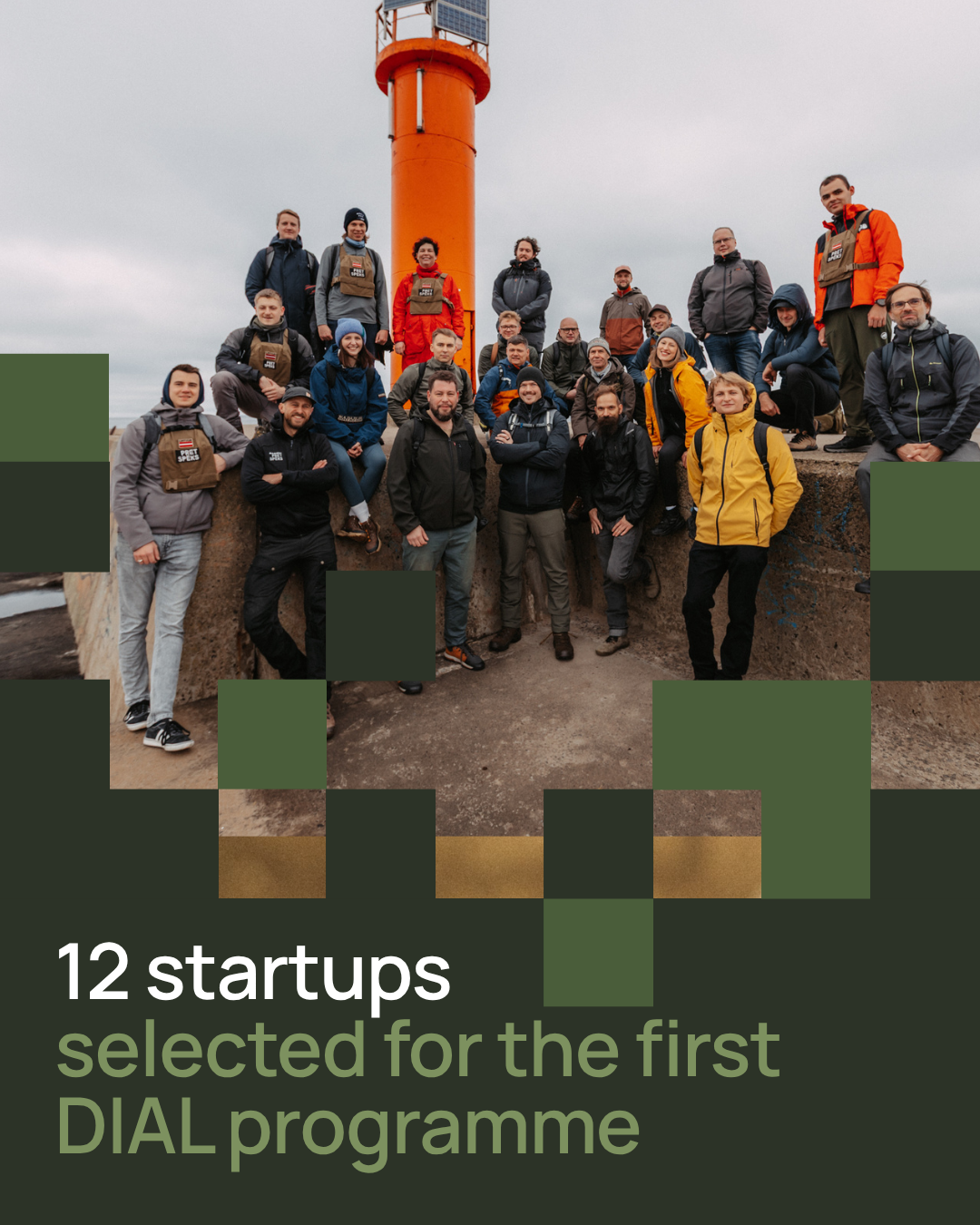
Twelve Latvian startups operating in the defence or dual-use technology sectors have been selected to participate in the first national defence pre-acceleration programme, DIAL (Defence Innovation Accelerator for Latvia). Each company will receive funding of up to €120,000, along with commercialisation support.
The national defence pre-acceleration programme DIAL has been established by the Ministry of Defence in cooperation with UniLab, the accelerator of Latvia’s research universities.
“Technological superiority and the ability to adapt rapidly to emerging threats are becoming increasingly important in modern warfare. Latvia is home to enterprising and talented people whose innovations have the potential to strengthen both our national defence capabilities and those of our allies. Through the DIAL programme, we are taking an important step towards turning these ideas into practical technologies. Our goal is to build a strong Latvian defence industry capable of meeting the needs of the National Armed Forces and competing in international markets. It is encouraging to see such strong interest and potential among Latvian startups already in the programme’s first call for applications,” emphasises Minister of Defence Raivis Melnis.
The main challenge area of this year’s DIAL programme is “Autonomy for Superiority”, with a particular focus on unmanned and autonomous systems, as well as technologies that enhance their performance and operational use in military applications.
The selection process took place in two stages, involving international experts with experience in the defence industry, military technology development and investment attraction. During the first stage, experts evaluated the companies’ applications, focusing on their technological solutions, defence applications and commercialisation potential. In the second stage, the companies met with experts in person to discuss their solutions, team capabilities and readiness to develop their businesses in the international defence market.
“When government institutions, universities, and businesses work together, we can quickly move from policy decisions to concrete action and from ideas to practical solutions that strengthen our defence capabilities. This time, we would particularly like to thank the Ministry of Defence for the speed with which the support programme was implemented. Just two weeks after the Cabinet of Ministers approved the DIAL regulations, we opened the call for applications. Another two weeks later, we had received more than 30 high-quality applications from startups. And just three weeks after that, the 12 selected startups are beginning their journey in DIAL, the only dedicated support programme for defence technology startups. Initially, the plan was to support five startups during the programme’s first year. However, given the strong interest and the high quality of the applications, the Ministry of Defence decided to provide funding and admit 12 startups to DIAL,” says Andris Baumanis, Head of UniLab.
The following teams have been admitted to the programme and will develop the following solutions:
- Detexity – “OrbiScan”: A 360° sensor node designed to detect and track FPV (First Person View) drones. It combines an event-based camera with embedded edge AI to identify the optical signature of drone propellers. The system is entirely passive, emitting no signals of its own and operating independently of radar, radio-frequency sensors, global navigation satellite systems, or communication networks. This enables highly accurate detection of modern drones, including those controlled via fiber-optic cables.
- Unfazed – “Sense On”: A portable system for the acoustic detection and interception of FPV drones, designed to provide early warning and protect soldiers, vehicles and other assets.
- Ardlat – CHPME (Compact HPM C-UAS Effector): A compact high-power microwave (HPM) effector designed to counter unmanned aerial systems. Unlike jamming devices, which merely disrupt drone communications, the system uses microwave pulses to permanently damage drone electronics.
- Comlab – “Hardmode”: A platform that can deploy an autonomous private 4G/5G network within minutes, using a ground robot, a vehicle or a ground-based installation. Devices interconnect and combine multiple communication technologies into a single network, ensuring connectivity even when commercial networks are unavailable.
- SUBmerge Baltic – “SUBmerge Modular Autonomy”: Mission-oriented command and control software for military unmanned underwater and surface vehicles.
- Ascent Lumina – Synthetic Data Generation Technology: A technology and platform for generating synthetic data to train computer vision AI models, enabling target detection and classification in images under a wide range of conditions.
- Sphere Tactical – “Sphere-Tac”: An artificial intelligence platform designed to accelerate tactical decision-making. It automatically consolidates fragmented information into a single platform, completing tasks that would normally take days in just minutes. The result is rapid, data-driven decision support for NATO combat engineering specialists.
- SEQ – “OffLoRe”: A portable and deployable sensor system that passively detects nearby wireless devices, air traffic signals, unmanned aerial vehicle signals and other radio-frequency anomalies. The system transmits its findings via a LoRaWAN network, eliminating the need for a mobile network or internet connection.
- NEWT21 – Target Recognition and Enhanced Surveillance for Small Unmanned Surface Vessels: A solution that enhances gyro-stabilized observation systems on small unmanned surface vessels, extending surveillance range and improving target identification and classification capabilities. It enables safer autonomous navigation in challenging maritime conditions and can be integrated into command, control, and communications systems.
- Rannon – “RATO”: A rocket-assisted take-off (RATO) subsystem that provides initial acceleration, enabling vehicles or aircraft to be launched from confined spaces without consuming onboard energy.
- Capitalg – “G-Host”: A modular small-arms integration system for unmanned platforms, combining target tracking, stabilized aiming and operator-authorized firing.
- Tactical Avionix – “Fixation”: A compact AI-powered vision solution for unmanned systems, enabling real-time object recognition and tracking even in environments with limited communications connectivity.
“Among these 12 teams, three startups — SUBmerge Baltic, Tactical Avionix and Capitalg — originated at research universities, initially beginning their journey in UniLab’s university pre-acceleration programme, Elevate. This demonstrates that the development pipeline is working.
“UniLab supports early-stage business ideas developed by research universities, students and researchers. The most promising ideas are offered additional support instruments at subsequent stages, enabling the startups to continue growing. The DIAL programme is currently the only opportunity for startups in Latvia to gain the momentum needed to create and develop critically important defence innovations,” says Elīne Lizandere, Head of UniLab’s defence initiative, UniLab Defence.
Over the next ten months, these companies will participate in pre-acceleration activities designed by international defense industry practitioners. The startups will have access to specialised experts and mentors from more than 15 countries, who will provide tailored support for commercialisation and international exports.
The selected companies will also gain access to military end users. Programme participants will have opportunities to validate their solutions in relevant operational environments in cooperation with the Latvian National Armed Forces and other international UniLab partners.
DIAL’s primary objective in defence technology commercialisation is to support startups and facilitate the establishment of partnerships worldwide, with a particular emphasis on North America.